
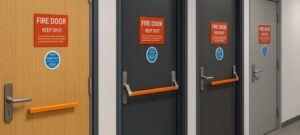
Schools catch fire for the same reasons offices and flats do. But a school fire moves through corridors packed with hundreds of children, not desks and photocopiers. That’s why fire door regulations in schools get scrutinised harder than almost any other building type.
If you manage a UK school, or you’re the one signing off on compliance, here’s what’s actually changed heading into 2026 and what’s worth checking now.
Schools have a risk profile most buildings don’t. High occupancy, young occupants who might panic rather than follow a drill calmly, and layouts with multiple wings, stairwells, and dead ends.
Fire doors for schools aren’t just about stopping flames spreading. They buy time. A door holding fire back for 30 or 60 minutes can be the difference between an orderly evacuation and something far worse.
Still the backbone of fire safety regulations UK schools operate under. It puts the “responsible person” — usually the headteacher or a business manager — on the hook for fire door checks, not just the local fire brigade.
This is Department for Education guidance written specifically for school buildings. It sets out where fire doors need to sit, how they should be rated, and how escape routes should be protected.
The British Standard covering timber fire door assemblies — installation, maintenance, the whole lifecycle. It isn’t law by itself, but it gets referenced constantly when schools need to prove compliance.
Scrutiny on fire doors has increased across every building type since Grenfell, and schools are no exception. Inspection frequency and record-keeping expectations have both tightened.
Red More: Fire Door Inspection Cost in Weston-super-Mare: A 2026 Pricing Guide
Redline Fire Doors has spent years fitting and inspecting fire doors for schools across the South West, so requests from bursars and site managers wrestling with fire door regulations in schools aren’t new territory.
The team knows what inspectors actually look for, which makes the difference between passing a check and finding out the hard way that a door’s been non-compliant for years.
If your school is near Weston-Super-Mare and due an inspection, get in touch with Redline Fire Doors at https://redlinefiredoors.co.uk
Yes. Under the fire safety regulations UK schools must comply with, fire doors are required on escape routes and around higher-risk areas like kitchens and boiler rooms.
Best practice for 2026 is quarterly visual checks, with a full professional inspection at least once a year — more often for doors on busy corridors that get heavy daily use.
The "responsible person" under the Fire Safety Order — typically the headteacher, site manager, or a delegated business manager — though most schools bring in specialists for the technical checks.
It depends on the door's location within the building. FD30 (30-minute fire resistance) is common for classroom and corridor doors, with FD60 used in higher-risk areas like plant rooms.
Yes. Fire and rescue authorities can issue enforcement notices and, in serious cases, prosecute — a far bigger cost than getting the doors right in the first place.