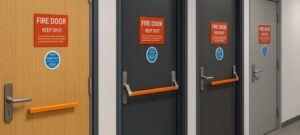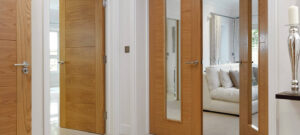

There isn’t one tidy rulebook called “the fire door law for homes”. What you actually get is a mix of building regulations, British Standards and sensible practice, and it’s easy to lose track of which bit applies to your house.
This guide sorts out what matters for homeowners in England in 2026: where fire doors are required, what the ratings mean, how fitting works, and what affects the price. Scotland, Wales and Northern Ireland have their own building rules, so check locally if you’re outside England.
In England, the domestic fire door regulations that matter most sit in the Building Regulations, mainly Approved Document B on fire safety. They apply when you build, convert or alter a home, not automatically to a house that’s stayed the same for decades.
For an ordinary two-storey house, that usually means you don’t need fire doors on every room. The rules bite when certain features are present.
If you’re unsure about your layout, your building control officer or a fire door specialist can confirm what applies.
FD30 means the door and frame have been tested to hold back fire for at least 30 minutes. The “S” means it also has smoke seals, which slow the spread of smoke before the flames arrive. FD60 doors are tested for an hour and turn up in higher-risk spots.
Look for a certification label or plug in the door edge, and keep any paperwork. A fire-rated leaf hung in a frame that isn’t up to the job won’t perform as tested.
Fitting a fire door is fussier than hanging an ordinary one, because performance depends on the whole assembly. In outline:
Skip a step, or trim the door beyond what the manufacturer allows, and you can undo the rating without anyone noticing.
More than most people expect, because you’re paying for a tested system rather than a slab of timber. The price depends on a few things.
Anyone asking how much a fire door costs will get a better answer from a written, itemised quote than from a rough online figure.
Confident DIYers can fit a fire door, and reading up on how to install a fire door is a sensible start. But the margin for error is small, and there’s no easy way to check the result afterwards. A badly fitted fire door can perform no better than an ordinary one.
Redline Fire Doors fits and inspects fire doors around Weston-super-Mare, and can tell you what your property needs before you spend anything.
Want a straight answer for your home? Talk to Redline Fire Doors at https://redlinefiredoors.co.uk
No. In most ordinary houses, only specific doors, such as the one to an integral garage or the rooms off a loft conversion stairway, need to be fire doors.
Usually, yes, typically an FD30S door in England. If your house was built before current rules or has been altered, check with building control.
A fire door costs noticeably more, because the leaf, frame, seals and hardware all have to work as a tested set. A quote for your specific openings is the only reliable figure.
There's no fixed legal schedule for a private home, but it's worth checking the gaps, seals and closer every few months. Landlords and HMOs have set duties.
Not where a fire door is required. Doing so can breach building regulations and may affect your insurance.